AI Visibility Index DACH 2026 — Collagen & Beauty Nutrition
Who's visible in AI answers, who's missing, and why
.svg)
A woman in her early forties is sitting on the sofa on a Sunday evening, iPad on her lap. She's seen three sponsored Instagram posts about collagen over the last few weeks, and now she wants to know more. She already asked the pharmacist at the local branch, but the answer was vague. Instead of clicking through ten comparison portals, she types into ChatGPT: "Best collagen supplement for firm skin". Four minutes later she has a shortlist of five brands. She knew three of them from social media; two are new. Before she even opens an online shop, the choice has been made.
This is the moment we measured. Which collagen supplement providers appear in this kind of dialogue, and which don't? That's AI Visibility, the visibility of a brand in the answers generated by AI systems. Measured at the point where modern purchase decisions in the beauty and health segment now begin.
The collagen supplements market is particularly instructive for this kind of measurement. Three very different types of providers compete with each other. On one side are specialised beauty nutrition brands like Glow25, RevitalTrax, Vida Glow and MyLily, often DTC-driven, with a strong presence on Instagram, TikTok and influencer marketing. Alongside them are established sports and fitness brands like Vital Proteins, ESN, WEIDER, Women's Best and Sports Research, which position collagen as an extension of their performance range. And finally the pharmacy and premium lines like Doppelherz, BIOGENA, Pure Encapsulations, Solgar and Kollagen Institut, which build visibility through pharmacy distribution, medical sources and trade press. On top of that comes the long tail of private labels, international importers and specialist providers who target niches such as marine collagen, vegan alternatives or pharmacy-grade quality.
Anyone trying to become visible in AI answers here is fighting on multiple fronts at once. The sources are heterogeneous, the competition is tight, and the platforms weight things differently than classical performance metrics would suggest.
What we measured
Together with Profound, we ran 25 prompts drawn from real collagen purchase journeys on ChatGPT, Google AI Overviews and Perplexity. Region: Germany. Period: April 2026. Each prompt was executed multiple times and every response was analysed.
The prompts split into five topic areas: Skin & Anti-Aging, Joints & Sports, Hair & Nails, Vitamins & Collagen Combination Products, and Competitive Comparison. Each of these areas represents a different moment in the purchase journey, from the first beauty question through athletic recovery to direct brand comparison just before ordering.
A total of 382 different providers and source entities appeared in the AI answers. The top 30 capture most of the share of voice; the remaining brands are distributed across a long tail with sometimes only individual mentions. A typical long-tail picture, with a small leading group and a broad, diffuse mid-field behind it.
Three metrics sit at the centre. The Visibility Score indicates in how many of the prompts a brand is mentioned in the AI response, expressed as a percentage. 30 % means: present in roughly every third answer. The Average Position shows how far up the list a brand appears. And the Citations make visible which sources the AI systems draw on when formulating a recommendation.
The overall ranking
Visibility Score across all three platforms, averaged over the measurement period.
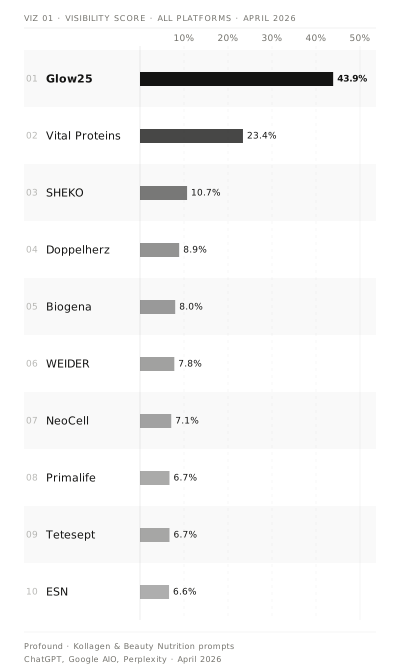
Three observations shape the picture. At the top, a leading pair has emerged that runs ahead with a clear margin. Glow25 with 43.9 % and Vital Proteins with 23.4 % define the modern collagen market in the DACH region in AI answers. Anyone asking a generic question about collagen supplements almost always gets one of these two brands in the response.
The second observation concerns the gap. More than 20 percentage points separate Glow25 in first place and Vital Proteins in second. Between Vital Proteins in second and SHEKO in third, another twelve percentage points. That's the sharpest dividing line we measure in the DACH beauty nutrition segment. Behind SHEKO, eight providers (Doppelherz, Biogena, WEIDER, NeoCell, Primalife, Tetesept, ESN, Doctor's Best) cluster in a narrow band between 5 and 9 %. The order there is unstable. An additional mention in one of the relevant comparison articles can shift positions by two or three places.
The third observation concerns the long tail. Of 382 brands and entities recorded, only a small portion reach Visibility values above 1 % at all. In the collagen market, the consequence is straightforward: anyone outside the top 30 essentially doesn't exist for the AI. Visibility is significantly more concentrated than the actual market structure, where dozens of smaller providers, pharmacy private labels and international importers are all active.
The Visibility Score alone doesn't tell the whole story. Equally important is how far up a brand appears in the response. In other words, whether it shows up as the first or the fifth recommendation.
| Provider | Avg. Position | Share of Voice |
|---|---|---|
| Women's Best | 1.0 | 1.0 % |
| Sunday | 1.3 | 0.8 % |
| Amazon | 1.3 | 0.8 % |
| RevitalTrax | 1.4 | 1.3 % |
| Nature Heart | 1.7 | n/a |
| BIOGENA | 1.7 | 1.6 % |
| SHEKO | 1.7 | 3.0 % |
| Biogena | 1.8 | 2.2 % |
| pureSGP | 1.9 | n/a |
| nu3 | 1.9 | 0.7 % |
| Vital Proteins | 2.2 | 4.3 % |
| Glow25 | 2.3 | 9.0 % |
Three observations matter here. First, Women's Best with an Average Position of 1.0 is statistically the best-positioned provider overall. When Women's Best is mentioned, it's almost always as the first recommendation. The visibility frequency is low at around 1 %, however, meaning the brand simply doesn't appear in many answers, but where it does, it appears prominently. This is the typical signature of a provider that runs through very few but heavily weighted sources, for example a concentrated brand presence in German-language women's-fitness comparison articles.
Second, the two leading providers in the Visibility ranking, Glow25 and Vital Proteins, sit at Average Positions of 2.3 and 2.2. When they appear in an answer, they consistently show up as first, second or third, rarely at the end of the list. That's an important finding, especially for the market leader. High frequency combined with high early position is a double anchoring that's harder to attack than pure frequency.
Third, RevitalTrax stands out. Position 1.4, Visibility rank 12 with 3.7 %. A brand that appears in significantly fewer answers than the top 5, but very far up the list when it does. Such providers typically depend on a handful of sources where they're consistently listed as a "top recommendation", for example in specialised anti-aging comparisons.
Three platforms, three rankings
None of the three platforms mirrors the overall ranking exactly. The deviations aren't cosmetic, they're structural.
ChatGPT
| Rank | Provider | Visibility Score |
|---|---|---|
| 1 | Glow25 | 78.0 % |
| 2 | Vital Proteins | 53.5 % |
| 3 | Doppelherz | 23.9 % |
| 4 | NeoCell | 21.4 % |
| 5 | WEIDER | 20.8 % |
| 6 | Tetesept | 20.1 % |
| 7 | ESN | 16.4 % |
| 8 | Doctor's Best | 15.1 % |
| 9 | gloryfeel | 12.6 % |
| 9 | NOW Foods | 12.6 % |
Google AI Overviews
| Rank | Provider | Visibility Score |
|---|---|---|
| 1 | Glow25 | 37.7 % |
| 2 | SHEKO | 21.2 % |
| 3 | Primalife | 19.2 % |
| 4 | Biogena | 17.8 % |
| 5 | ARD Mediathek | 16.4 % |
| 6 | YouTube | 14.4 % |
| 7 | Vital Proteins | 11.6 % |
| 8 | Fairnatural | 11.0 % |
| 9 | ARD | 9.6 % |
| 9 | VOGUE | 9.6 % |
Perplexity
| Rank | Provider | Visibility Score |
|---|---|---|
| 1 | Glow25 | 16.2 % |
| 2 | Olimp | 12.1 % |
| 3 | Natu.Care | 11.1 % |
| 4 | MyLily | 10.1 % |
| 4 | SHEKO | 10.1 % |
| 6 | BIOGENA | 9.1 % |
| 6 | Natural Elements | 9.1 % |
| 8 | RevitalTrax | 7.1 % |
| 8 | Women's Best | 7.1 % |
| 10 | Biogena | 6.1 % |
Three platforms, three rankings, one market. Glow25 leads on all three platforms, but with dramatically different values: 78 % on ChatGPT, 37.7 % on Google AI Overviews, only 16.2 % on Perplexity. A spread of around sixty percentage points between the platform maximum and the platform minimum. That's the typical signature of a provider whose visibility is built on one dominant platform and which falls below the level on others that the overall market position would suggest.
Vital Proteins shows a related pattern, in significantly attenuated form. ChatGPT 53.5 % at rank 2, Google AI Overviews only rank 7 with 11.6 %, Perplexity not in the top 10 at all. Vital Proteins has built a strong English-language source base over the years, primarily in US lifestyle and health magazines that ChatGPT cites disproportionately. In the German-language comparison media that Google AI Overviews and Perplexity weight more heavily, this anchoring falls away.
On Google AI Overviews the ranking shifts fundamentally. In positions 5, 6 and 9/10 stand not brands but source entities: ARD Mediathek, YouTube, ARD and VOGUE. That's a peculiar effect, typical for German-language beauty and health topics. Google cites magazine titles and broadcaster names directly as sources and assigns them visibility values that wouldn't exist in pure brand logic. For classical brands this means: on Google AI Overviews they don't only compete with each other, but also with the sources the platform draws on.
Perplexity shows the opposite pattern. Many classical brands from the ChatGPT ranking play no role here at all. Doppelherz, NeoCell, WEIDER, Tetesept, ESN, all in the ChatGPT top 10, drop out of the top 10 on Perplexity. Instead, providers appear that are less visible on the other two platforms: Olimp, Natu.Care, MyLily, Natural Elements, BIOGENA. Perplexity weights German- and Polish-language specialist sources differently, which reflects directly in the rankings.
Anyone aligning their AI strategy to a single platform has systematic gaps on the others. In the collagen market this is particularly consequential because buyers go about it very differently. The typical beauty buyer researches more often via ChatGPT or Google AI Overviews. Sport-oriented users search more often via Google AI Overviews. Users with higher research demands (medical, ingredient-focused) reach more often for Perplexity. The same platform asymmetry visible in the dataset translates into purchase behaviour across three different personas.
Who wins which topic area?
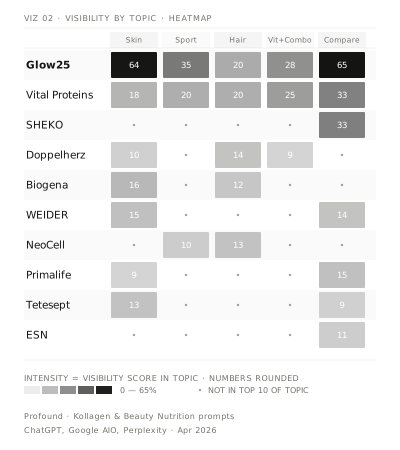
The overall ranking shows who appears most often in aggregate. What it doesn't show: which specific questions a brand is present for, and which it isn't.
Skin & Anti-Aging
"Recommend the best collagen supplement for firm skin", "Recommend a collagen supplement for visible skin improvement", "Recommend an anti-aging supplement with collagen for women", and others.
| Rank | Provider | Visibility Score |
|---|---|---|
| 1 | Glow25 | 64.4 % |
| 2 | Vital Proteins | 17.7 % |
| 3 | RevitalTrax | 17.0 % |
| 4 | BIOGENA | 16.4 % |
| 5 | WEIDER | 14.7 % |
The most emotionally charged category in the market, and Glow25 dominates it clearly. 64.4 % means: in roughly two out of three anti-aging queries, Glow25 appears in the answer. That's the highest single value any provider reaches in this study. Vital Proteins in second with 17.7 %, RevitalTrax close behind with 17.0 %, BIOGENA in fourth with 16.4 %.
What additionally stands out here is the absence of classical pharmacy brands from the top 5. Doppelherz, which sits at rank 4 in the overall view, falls to rank 7 in this category with 9.8 %. Tetesept at rank 6 with 12.8 %. Pure Encapsulations not in the top 10 at all. Anti-aging as a question is predominantly answered by beauty specialists in AI responses, less so from the pharmacy side. That mirrors the source base: anti-aging comparisons run in beauty magazines like VOGUE, Harper's Bazaar or lifestyle portals, not in the classical pharmacy environment.
Competitive Comparison
"Premium collagen supplement comparison — which brand is worth it?", "Recommend an affordable collagen alternative to expensive branded products", "Best collagen supplement Germany quality and price", and others.
| Rank | Provider | Visibility Score |
|---|---|---|
| 1 | Glow25 | 65.4 % |
| 2 | SHEKO | 33.4 % |
| 3 | Vital Proteins | 33.3 % |
| 4 | Olimp | 15.3 % |
| 5 | Primalife | 15.2 % |
Competitive comparisons are the second category in which Glow25 leads with a clear margin. 65.4 % is even marginally higher than the anti-aging value. Directly behind, almost level, SHEKO with 33.4 % and Vital Proteins with 33.3 %. Behind this leading trio another gap opens up: Olimp and Primalife in fourth and fifth with around 15 % each.
What makes this category instructive is the mix of two question types. Generic comparison questions like "Premium collagen supplement comparison" measure which brands the AI offers as the "first set" when no specific brand is given. Glow25, SHEKO and Vital Proteins dominate here. Specific alternative questions like "Recommend an affordable collagen alternative to expensive branded products" measure the substitution set. In this question Olimp, Primalife, Fairnatural and ESN appear more frequently. Brands, in other words, that connect semantically with "alternative" and "value for money" in the source corpus.
SHEKO at rank 2 is a special case. SHEKO is present in mainstream comparison contexts, but as a meal replacement with collagen, not as a pure collagen supplement. AI answers cite SHEKO regularly in comparisons because the brand is tagged with the corresponding keywords in German beauty and lifestyle comparison articles.
Vitamins & Collagen Combination Products
"Recommend collagen with vitamin C for joints", "Recommend a vegan collagen booster supplement with vitamin C", "Recommend a collagen combination preparation with vitamins and minerals", and others.
| Rank | Provider | Visibility Score |
|---|---|---|
| 1 | Glow25 | 28.2 % |
| 2 | Vital Proteins | 24.8 % |
| 3 | Sunday Natural | 13.7 % |
| 4 | pureSGP | 11.1 % |
| 5 | Pure Encapsulations | 10.0 % |
The only category where Glow25 and Vital Proteins are nearly level. The gap is just 3.4 percentage points. That's revealing because here it's not beauty branding that decides but the perceived scientific reliability. Vital Proteins benefits in this category from its international health profile with ingredient-focused product information.
Sunday Natural at rank 3 with 13.7 % is the first pharmacy/health specialist brand to become visible. Sunday Natural runs an extensive knowledge hub with detailed ingredient profiles, which gets cited disproportionately in this more fact-oriented category. pureSGP and Pure Encapsulations in fourth and fifth show the same pattern. Both are well anchored in pharmacy-adjacent and health-oriented comparison articles, less so in the beauty mainstream.
What also stands out in this category: Doppelherz, sitting at rank 4 in the overall ranking, only appears here at rank 9 with 8.6 %. A pharmacy brand that sees itself as a vitamin and combination preparation specialist is not mentioned in the top five of the AI response to exactly this question. That's one of the most instructive discrepancies in the entire report.
Joints & Sports
"Recommend a collagen supplement for recovery after sport", "Recommend the best collagen supplement for female athletes", "Recommend a collagen supplement for joints and cartilage", and others.
| Rank | Provider | Visibility Score |
|---|---|---|
| 1 | Glow25 | 35.2 % |
| 2 | Vital Proteins | 19.5 % |
| 3 | Kollagen Institut | 12.7 % |
| 4 | Women's Best | 11.1 % |
| 4 | Natu.Care | 11.1 % |
Glow25 leads in the sports and joints segment too, although with significantly reduced dominance compared to Anti-Aging and Competitive Comparison. 35.2 % versus 64.4 % in the anti-aging comparison means: roughly halved. The category is more open.
At rank 3, Kollagen Institut appears as a specialised German brand that's less visible in the overall ranking (rank 19 in Average Position, rank 25 in Visibility Score) but stands out clearly in the sports category. Kollagen Institut runs one of the most-cited brand hubs of the category at kollageninstitut.de, with content strongly oriented towards joints, cartilage and recovery. The brand is a textbook example of how a topic-specific hub in a narrow category carries more weight than broad brand reach.
Women's Best at rank 4 is the only pure women's-sport brand in the top 5 of this category. It reflects the strong anchoring in the female fitness segment, where collagen is positioned primarily as a recovery booster rather than as a beauty supplement.
Pure sport brands like Sports Research, OstroVit or Vitabiotics only appear from rank 7 onwards. In the athletic first contact with collagen, the beauty crossover brands are apparently recommended more often than the specialised performance brands.
Hair & Nails
"Recommend a collagen supplement for hair growth", "Recommend a supplement against hair loss for women", "Recommend a collagen and biotin combination preparation for hair", and others.
| Rank | Provider | Visibility Score |
|---|---|---|
| 1 | Glow25 | 20.0 % |
| 2 | Vital Proteins | 19.6 % |
| 3 | Bioxcin | 13.8 % |
| 4 | Doppelherz | 13.6 % |
| 5 | Life Extension | 12.8 % |
| 5 | NeoCell | 12.8 % |
The most open category in the study. Glow25 and Vital Proteins are nearly level with just 0.4 percentage points between them. Directly behind, in a tight band between 12 and 14 %, sit Bioxcin, Doppelherz, Life Extension and NeoCell. Seven providers between 8 and 20 %, no clear market leader.
The reason for this spread is straightforward. Hair and nail supplements are not established in the German-language source world as a collagen domain, but as a biotin, zinc and multi-nutrient domain. The AI therefore regularly adds specialised hair-and-nail brands (Bioxcin, NeoCell, Life Extension) to its answer, brands that wouldn't appear in the top 5 of pure collagen questions outside this category.
Bioxcin at rank 3 is a notable outsider. A Turkish-international brand that appears regularly in German AI answers about hair and nail supplements because it's listed in a number of German-language beauty and drugstore comparison articles. A classical citation effect: anyone mentioned in the right ten comparison articles automatically gains visibility in the AI response, regardless of their market relevance in the narrower sense.
How AI processes questions
When ChatGPT receives a question, the system doesn't answer it directly from memory. Instead, several related search queries are formulated internally, and their results are then merged. These internal queries are called fanout queries. The AI system "fans out" the user question into multiple sub-queries and assembles a more comprehensive answer from the hits.
In our dataset, fanouts averaged 1.94 queries per execution. Each of our prompts therefore stands for roughly two sub-questions running in parallel.
An example: for the prompt "Recommend collagen with vitamin C for joints", an average of 2.14 queries per execution were generated. The most common fanouts were variations like "best collagen with vitamin C supplements for joints", "collagen with vitamin C joint supplements" and "Kollagen Vitamin C Supplement Gelenke". The original German question was played out in multiple parallel sub-steps in both German and English before the answer was assembled.
This is an effect that structurally affects DACH providers. For ingredient-focused questions, the internal search runs partly in English, which favours international brands like Vital Proteins, NeoCell or Sports Research. For more emotional questions around skincare, anti-aging and beauty, the search stays closer to the German-language corpus, which makes brands with DACH anchoring and German earned-media presence visible disproportionately.
The same brand can sit far up the list in one question and barely appear in another through this difference in source architecture. Not because of different product quality, but because of different source mechanics.
What AI actually reads
The Visibility Scores show who's at the top. The citation analysis explains why.
The dataset comprises over 1,100 citation pages from 573 different domains. The distribution by source type:
| Category | Citation Share |
|---|---|
| Other (incl. brand hubs & specialist content) | 52.9 % |
| Earned Media (trade press, lifestyle, health magazines) | 34.4 % |
| Institution (public broadcasters, consumer protection) | 8.3 % |
| Social Media (YouTube, Reddit, dev.to) | 4.4 % |
This distribution is typical for the collagen market and differs significantly from B2B categories. Earned Media carries a much larger share at 34.4 % than in B2B software markets, where brand hubs typically dominate three-digit. In the collagen market, classical newsrooms, lifestyle magazines and health portals are therefore the second large source pillar alongside provider and specialist hubs.
The relatively high institutional share of 8.3 % is also notable. ARD Mediathek, the German consumer protection authority Verbraucherzentrale and the American NIH deliver measurable citation share in this category. That's a consequence of the health subject matter. AI systems draw on public institutions more often for efficacy, dosage and safety questions than for pure product and performance questions.
Top citation domains
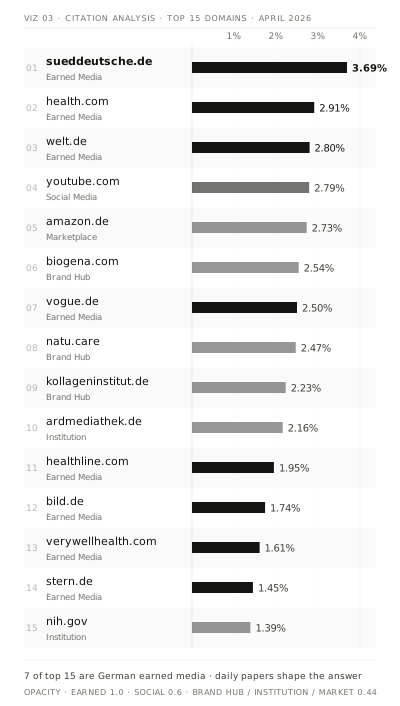
Several observations from this data warrant a closer look.
sueddeutsche.de at rank 1 with 3.69 %. A daily newspaper as the most-cited domain in a beauty and health category. The reason doesn't lie in the classical editorial section, but in the comparison and advisory section sueddeutsche.de/supplements/kollagen/kollagen-test, which belongs to the most-cited individual pages of the entire dataset. The same pattern shows for welt.de and bild.de in third and twelfth. German daily newspapers have built out affiliate and comparison sections on a large scale in recent years, sections that get cited far disproportionately in AI answers. Anyone listed there inherits a substantial visibility foundation. Anyone not listed has a measurable gap.
health.com at rank 2 with 2.91 % shows the other side. A US health-lifestyle domain that's cited disproportionately on ChatGPT, where the source base is broader and more international. Healthline.com (rank 11) and verywellhealth.com (rank 13) follow the same pattern. These three domains are the English-language anchors through which international brands like Vital Proteins, NeoCell, Sports Research and Doctor's Best build their visibility on ChatGPT.
YouTube at rank 4 with 2.79 %. As in previous reports of the series, YouTube is one of the central citation sources, and that's no coincidence. Beauty tutorials, product reviews, collagen experience reports. AI systems access transcripts and descriptions of these videos. In classical beauty and health marketing strategies, YouTube is often treated as a pure reach channel. In the AI context, YouTube is measurably a citation source whose content flows directly into the response.
amazon.de at rank 5 with 2.73 %. Notable because Amazon is not a brand hub in classical SEO terms but a marketplace. In the AI context, however, Amazon product pages and especially Amazon reviews flow directly into answer formation. Anyone with a strong listing presence there gets cited. That applies both to the brand Amazon itself (which sits at rank 3 in the Average Position table) and to the individual listed providers.
vogue.de at rank 7 with 2.50 %. The only pure premium-lifestyle media domain in the top 10. VOGUE runs an extensive beauty comparison section that's cited disproportionately in German-language anti-aging answers. Similar to OMR in the B2B space, VOGUE is a domain you can't strategically avoid in the DACH beauty market.
biogena.com (rank 6, 2.54 %), natu.care (rank 8, 2.47 %) and kollageninstitut.de (rank 9, 2.23 %) are the most-cited provider hubs of the category. Three providers that build their visibility substantially through their own content hubs. BIOGENA with long-curated ingredient and knowledge articles, Natu.Care with a strongly source-driven health magazine on its own domain, Kollagen Institut with a topic-focused hub strategy around the application of collagen in specific health contexts. None of the three benefits in their own visibility as dominantly as their citation share would suggest, but they deliver a large part of the raw material the AI uses to derive rankings of other providers.
ardmediathek.de at rank 10 with 2.16 %. A public institution. Reports, consumer features and documentary formats on collagen are regularly drawn upon in AI answers, especially in Google AI Overviews. Anyone trying to become visible in the collagen market should treat ARD content not just as consumer information but as a citation source cited in a critical position for purchase-near questions.
Reddit at rank 42 with 0.5 %. Low in the overall view but structurally interesting. Reddit threads about collagen experiences are regularly cited by ChatGPT and Perplexity, especially for experience and comparison questions. Even if the absolute citation share is modest, Reddit has measurable influence in individual answer types.
Conclusion: Where each brand stands, and where potential remains

Glow25 dominates the market in a way that doesn't appear anywhere else in this series. 43.9 % overall visibility, top position on all three platforms, rank 1 in five out of five topic areas. The only category where the lead is narrow is Hair & Nails, with 20.0 % versus Vital Proteins' 19.6 %. Otherwise, Glow25 is so strongly anchored in Anti-Aging with 64.4 % and in Competitive Comparison with 65.4 % that the brand appears in every other to two of three answers in these categories. What carries the position is an unusually broad citation base spanning German-language lifestyle and beauty magazines (VOGUE, Harper's Bazaar, GQ), daily newspaper comparisons (Süddeutsche, Welt, Bild), health portals and a strong own domain. On ChatGPT with 78 %, the brand sits far above what would structurally be expected. On Perplexity with 16.2 %, however, significantly weaker than the ChatGPT position would suggest. The lever for the coming quarters lies in consistently broadening the source base across the German-language specialist domains that Perplexity weights more heavily.

Vital Proteins at rank 2 with 23.4 %. The position owes less to a beauty anchoring in the DACH market than to the international earned-media presence on domains like health.com, healthline.com and verywellhealth.com. On ChatGPT with 53.5 %, Vital Proteins sits clearly ahead of all others. On Google AI Overviews with 11.6 %, only rank 7. On Perplexity not in the top 10 at all. That's the typical signature of a US-driven brand build that's anchored in the English-language lifestyle world and shows up comparatively thinly in German-language comparison and specialist media. Strategically meaningful would be a systematic broadening into German health and lifestyle sources cited beyond ChatGPT.

SHEKO at rank 3 with 10.7 %, in Competitive Comparison at rank 2 with 33.4 %, Average Position 1.7. On Google AI Overviews at rank 2 with 21.2 %, on Perplexity in the top 5 with 10.1 %. SHEKO is, strictly speaking, not a classical collagen supplement but a meal replacement with collagen. In AI answers, however, the brand is consistently mentioned in collagen comparisons because it's tagged accordingly in German beauty and lifestyle comparison articles. That's an instructive effect: visibility in AI is not primarily a function of product category, but of the semantic linkage in the sources. Anyone appearing in the right comparison articles gains visibility even outside their actual product category. The Average Position of 1.7 is notable. When SHEKO is mentioned, it's far up the list. What's strategically missing is anchoring in the emotionally charged anti-aging and skincare sources, where the brand is less visible than the competitive and Google position would suggest, despite a strong lifestyle presence.
Doppelherz at rank 4 with 8.9 %, rank 4 in Hair & Nails. The classical pharmacy brand that builds its visibility through a broad multi-nutrient range. What stands out is the discrepancy between the brand perception in the pharmacy context and the position in specific collagen questions. In Vitamins & Collagen Combination Products, the most natural category for a pharmacy brand, Doppelherz drops to rank 9 with 8.6 %. In its self-perception, Doppelherz is positioned as a vitamin and combination specialist, but in the AI response to exactly this question, specialised brands appear earlier. A measurable gap between self-positioning and AI visibility, leaving a lot unused in the volume answers.
Biogena at rank 5 with 8.0 % (additionally BIOGENA as a separate brand spelling with 4.9 %, rank 4 in Skin & Anti-Aging with 16.4 %). The Austrian premium pharmacy brand whose visibility is carried to a large extent through its own brand hub at biogena.com (rank 6 of citations with 2.54 %, one of the strongest provider hubs in the entire category). On Perplexity, BIOGENA moves into the top 6 with 9.1 %, significantly better than the overall position would suggest. That's an instructive pattern: the domain carries the brand precisely on the specialist-oriented platform above average. Strategically, this means for comparable pharmacy-premium brands that a topic-structured knowledge hub with ingredient and application articles represents a measurable visibility lever in Perplexity-focused answers.

Sunday Natural at rank 18 overall with 4.4 %, in Vitamins & Collagen Combination Products at rank 3 with 13.7 %. Sunday Natural is one of the most instructive mid-field examples in this study. The Berlin premium brand runs one of the most substantial knowledge hubs in the category at sunday.de (rank 48 of citation domains with 0.45 %), publishing detailed ingredient and application articles. This structured hub strategy pays off precisely where things get technically demanding: in the combination preparations category at rank 3, ahead of established pharmacy brands like Pure Encapsulations and Doppelherz. What Sunday Natural lacks is the emotional anti-aging and beauty anchoring in German lifestyle magazines. A gap that can be addressed strategically and directly, without diluting the technical positioning.

Natu.Care at rank 21 overall with 4.1 %, in Joints & Sports at rank 4 with 11.1 %, in Hair & Nails at rank 10 with 8.3 %. On Perplexity with 11.1 % at rank 3. Natu.Care runs one of the most citation-strong domains of the entire category at natu.care (rank 8 with 2.47 %), a position that's exceptional for a relatively young European brand. The brand hub functions as a health magazine with independent editorial content that AI systems treat like a neutral specialist portal. The Natu.Care example shows how a consistently built knowledge hub can lift a brand into the top 4 of a topic category without requiring classical earned-media investments in lifestyle magazines. The next lever lies in consistently broadening beyond Perplexity, especially into the ChatGPT-relevant international health sources.

nu3 at rank 27 in Visibility with 3.4 %, Average Position 1.9. The German health-nutrition brand runs one of the more substantial brand hubs in the category at nu3.de (rank 18 of citation domains with 1.04 %). What's notable is the discrepancy between hub strength and brand visibility. nu3 measurably delivers citation material through its own domain but benefits in its own visibility less than brands with comparable hub presence such as BIOGENA or Natu.Care. The position is the typical signature of a provider that has built its hub as a knowledge platform without consistently using it as a brand anchor. When nu3 is mentioned, it's early in the answer (Position 1.9), which suggests credible source embedding. The greatest visibility potential lies in linking the existing hub substance more strongly to the nu3 brand semantically, for example through clearer brand-context signals in the knowledge articles and a more congruent anchoring in German lifestyle and beauty comparisons, where nu3 currently appears below its own hub level.
Kollagen Institut at rank 25 in Visibility, in Joints & Sports at rank 3 with 12.7 %. A German specialist brand that positions itself in the category through an exceptionally topic-focused brand hub: kollageninstitut.de sits at rank 9 of citation domains with 2.23 %. That makes the domain one of the most-cited hubs in the entire category, far above what the brand visibility itself would suggest. Kollagen Institut is a textbook example of how a topic-specific domain strategy can carry a brand forward in a narrow specialist category. The own-visibility lever lies in transferring hub knowledge more strongly into brand-relevant recommendation answers, not just into neutral knowledge answers.
Behind the brands discussed here in detail follows a dense mid-field between rank 6 and 30, in which sport and performance brands like WEIDER, NeoCell, ESN and Sports Research draw their visibility predominantly from international performance sources, classical pharmacy and drugstore brands like Tetesept, Pure Encapsulations and Solgar remain anchored in the pharmacy ingredient world, and platform-specific brands like Primalife (Google AI Overviews), Olimp (Perplexity) or Doctor's Best (ChatGPT) build their position almost entirely on a single platform. In the closer long tail, further DACH and international providers appear like Fairnatural, MyLily, RevitalTrax, Vida Glow, Women's Best, gloryfeel and Bioxcin, each with a clearly recognisable specialist signature in one or two topic areas.
For the DACH collagen market overall, the rule is: visibility is significantly more concentrated than the actual market. While dozens of smaller brands actively market themselves, only around 30 of 382 recorded brands reach visibility above 1 %. Anyone not anchored in the right comparison articles, lifestyle magazines, daily newspaper comparison sections, health portals and provider hubs simply doesn't appear in the AI answer. The source mechanics are measurable, they distribute differently across three platforms, and they respond to strategic source work within quarters, not years. Anyone present there becomes visible in the relevant recommendation position. Anyone missing remains in a long tail that doesn't appear in the answer in practice.
What Recon Rise does
This report shows the category. We show where your brand stands within it, and then build what's missing.
An AI Visibility Audit measures current visibility on ChatGPT, Google AI Overviews and Perplexity, broken down by topics, platforms and positions. After that, the operational work begins: building the sources AI draws on for your category. Placing earned media, developing comparison content, setting up data structures. The infrastructure that ensures your brand appears in the right answers. Permanently, not as a one-off.
For anyone wanting to know what this looks like for their own brand: Get in touch
Methodology
Profound AI Visibility Monitoring · 25 prompts across 5 topic areas: Skin & Anti-Aging, Joints & Sports, Hair & Nails, Vitamins & Collagen Combination Products, Competitive Comparison · Measurement period: April 2026 · Platforms: ChatGPT, Google AI Overviews, Perplexity · Multiple executions per prompt and platform · 382 unique brands and source entities identified · Citation analysis based on 573 unique domains and 1,100 unique pages · Region: Germany · Category: Collagen & Beauty Nutrition
AI Visibility Index DACH 2026 — Collagen & Beauty Nutrition Recon Rise GmbH · Düsseldorf · reconrise.ai © 2026 Recon Rise. All rights reserved.
Recon Rise, Düsseldorf · reconrise.ai
© 2026 Recon Rise. Alle Rechte vorbehalten.