AI Visibility Index DACH 2026 — Human Risk Management
Which brands show up in AI answers, which don't, and why
.svg)
An IT manager at a German mid-sized company sits down at the laptop on a Tuesday evening. The NIS-2 deadline is approaching, the CFO is waiting on a plan for the security awareness training, and the tool that has been running for three years is being clicked through by employees without much engagement. Before he lines up five demo calls for Monday, he types into ChatGPT: "Recommend a GDPR-compliant security awareness solution with German-language trainings." He gets four names, opens two of them, has a shortlist in his head. Before a single sales conversation has even taken place, three or four other vendors are already out of the running.
That is the moment we measured. Not Google rankings, not impressions, not brand surveys — but the question of which brands show up in the answers from ChatGPT, Perplexity and Google AI Overviews when a buyer in the DACH region looks for a security awareness solution.
Human Risk Management is a particularly revealing category for this kind of measurement. NIS-2 is tightening the market noticeably: thousands of European companies now have to document an awareness training for the first time. The relevant vendors come from Europe and the US — SoSafe from Cologne, KnowBe4 from Florida, Proofpoint and Cofense from the US email security segment, Hoxhunt from Helsinki, MetaCompliance from Belfast, Guardey from the Netherlands. Plus a German midfield with G DATA, IS-FOX, Hornetsecurity and a handful of smaller specialists. Regulatory tailwind combined with direct European competition creates a market in which visibility can be measured cleanly.
What we measured
25 prompts drawn from real security awareness buying processes, run on ChatGPT, Google AI Overviews and Perplexity. Region: Germany. Timeframe: April 2026. Each prompt was executed multiple times, each answer evaluated. We measured with Profound.
The prompts cover five buying moments: Security Awareness Training, Phishing Simulation, NIS-2 & Compliance, Human Risk Management, Competitive Comparison.
In total, the answers featured 317 different vendors. Most of them only once. The top 15 share around 54 percent of Share of Voice; the rest is distributed across more than 300 brands with sporadic mentions. A long-tail distribution, as in most B2B categories we have measured.
Three metrics matter. The Visibility Score shows how many of the 25 prompts include a given brand — 63 percent means the brand appears in almost every other relevant query. Average Position indicates how far up in the answer the brand is mentioned. And Citations reveal which sources the AI actually pulls from before formulating a recommendation.
The overall ranking
Visibility Score across all three platforms, averaged over the measurement period.
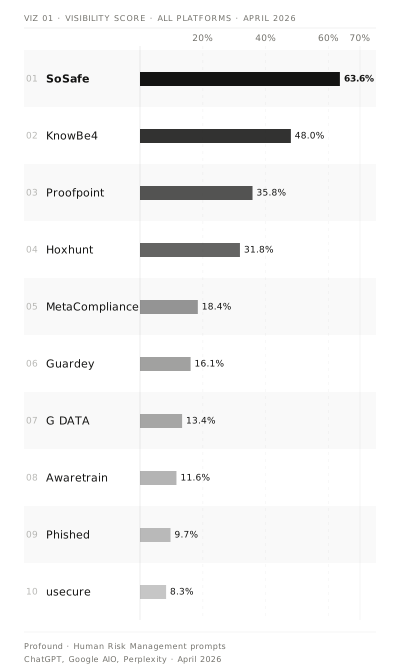
Rank 1 is nearly 16 percentage points ahead of rank 2. This is the widest lead at the top we have seen so far in this report series. For comparison: in Spend Management, ranks 1 and 2 were separated by just 0.4 percentage points. In the SMP market, SAP dominated without challenge, but via a completely different mechanism — gravitational pull from decades of industry-press coverage. Here it is different. The gap comes from a vendor that has been working its category very consistently over many years.
Behind the leader, a second tier: Proofpoint and Hoxhunt between 32 and 36 percent. Then a marked drop to MetaCompliance, Guardey and G DATA between 13 and 19 percent. In this midfield, the vendors sit close enough together that a single bigger article in a relevant source could reshuffle positions within a few weeks.
The Visibility Score tells only half the story. Equally important is how early in the answer a brand appears — first recommendation, or fifth.
| Vendor | Avg. Position | Share of Voice |
|---|---|---|
| SoSafe | 1.7 | 13.31% |
| KnowBe4 | 2.2 | 9.94% |
| Proofpoint | 3.0 | 7.46% |
| Hoxhunt | 3.1 | 6.18% |
| usecure | 3.2 | 1.50% |
| G DATA | 3.7 | 2.86% |
| Guardey | 4.1 | 3.62% |
| Awaretrain | 4.3 | 2.36% |
| MetaCompliance | 4.6 | 3.39% |
| Phished | 4.6 | 1.90% |
SoSafe averages position 1.7. When the brand appears, it almost always appears first or second. No other brand in the category comes close to that. KnowBe4 at 2.2 is half a position behind; Proofpoint and Hoxhunt sit around position 3 on average.
For a buyer who scrolls through a ChatGPT answer, that is meaningful. The first two or three names get noticed. From position 5 onwards, it gets hard. KnowBe4 holds its second place solidly with 48 percent Visibility Score and position 2.2 — the gap to SoSafe doesn't come from few appearances, it comes from the fact that SoSafe shows up in more prompts and more often as the first name mentioned.
Three platforms — three different rankings
None of the three platforms mirrors the overall ranking. The differences are not cosmetic.
The following values show the Visibility Score of the ten dominant competitors in the category, broken down by platform.
ChatGPT
| Rank | Vendor | Visibility Score |
|---|---|---|
| 1 | SoSafe | 54.3% |
| 1 | KnowBe4 | 54.3% |
| 3 | Hoxhunt | 49.0% |
| 4 | Proofpoint | 39.7% |
| 5 | MetaCompliance | 37.1% |
| 6 | usecure | 18.5% |
| 7 | Phished | 13.2% |
| 8 | Awaretrain | 12.6% |
| 9 | G DATA | 7.9% |
| 10 | Guardey | 7.3% |
Google AI Overviews
| Rank | Vendor | Visibility Score |
|---|---|---|
| 1 | SoSafe | 84.8% |
| 2 | KnowBe4 | 46.2% |
| 3 | Proofpoint | 33.3% |
| 3 | Hoxhunt | 33.3% |
| 5 | G DATA | 21.2% |
| 6 | Guardey | 16.7% |
| 7 | MetaCompliance | 15.2% |
| 7 | Awaretrain | 15.2% |
| 9 | Phished | 12.9% |
| 10 | usecure | 5.3% |
Perplexity
| Rank | Vendor | Visibility Score |
|---|---|---|
| 1 | SoSafe | 51.5% |
| 2 | KnowBe4 | 43.4% |
| 3 | Proofpoint | 34.3% |
| 4 | Guardey | 24.2% |
| 5 | Hoxhunt | 13.1% |
| 6 | G DATA | 11.1% |
| 7 | Awaretrain | 7.1% |
| 8 | Phished | 3.0% |
| 8 | MetaCompliance | 3.0% |
| 10 | usecure | 1.0% |
Google AI Overviews shows SoSafe at 84.8 percent. The brand appears in almost every answer. On ChatGPT in the same period: 54.3 percent, tied with KnowBe4. 30 percentage points of difference between two platforms, for the same brand, in the same week.
KnowBe4 is co-leader on ChatGPT, clearly rank 2 on Google AI Overviews, rank 2 on Perplexity as well. Anyone opening ChatGPT hears KnowBe4 just as often as SoSafe. Anyone checking Google AI Overviews sees SoSafe with a bigger lead. The reason lies in the sources the platforms use to build their answers: on ChatGPT, most citations come from English-language authority sources like Wikipedia, Gartner and G2 — and as the global market leader, KnowBe4 has had a dense footprint there for years. On Google AI Overviews and Perplexity, German-language trade portals like security-insider.de, it-daily.net and capterra.com.de play the leading role, and SoSafe has the denser profile there.
Hoxhunt demonstrates the same pattern from the opposite direction: 49 percent on ChatGPT, only 13 percent on Perplexity. Guardey runs entirely against the grain. Rank 4 on Perplexity with 24 percent, rank 10 on ChatGPT with 7 percent. A Dutch brand that has worked deliberately into the sources Perplexity draws on — comparison portals, review sites. On ChatGPT, which constructs its authority differently, Guardey is barely visible.
The platform specificity is starkest at MetaCompliance: 37 percent on ChatGPT, 3 percent on Perplexity. 34 percentage points of delta for a single brand.
The strategic implication is uncomfortable: anyone who aligns their AI visibility strategy to a single platform will have blind spots on the others. In a market where SoSafe, KnowBe4, Proofpoint and Hoxhunt largely address the same mid-market and enterprise buyers, platform coverage plays a real role in determining which brands a buyer even has on the radar.
Who wins which buying moment?
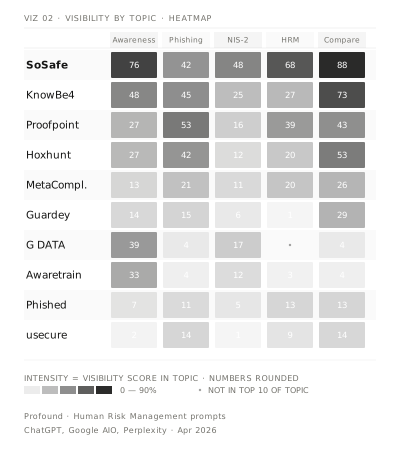
The overall ranking shows the average frequency. What it doesn't show: in which concrete questions a brand is present, and in which ones it isn't.
Security Awareness Training
"Which security awareness training platform do you recommend for companies in Germany?" — "Recommend a GDPR-compliant security awareness solution with German-language trainings" — "Cybersecurity e-learning that employees will actually use instead of just clicking through" — etc.
| Rank | Vendor | Visibility Score |
|---|---|---|
| 1 | SoSafe | 76.3% |
| 2 | KnowBe4 | 48.1% |
| 3 | G DATA | 39.1% |
| 4 | Awaretrain | 33.3% |
| 5 | Proofpoint | 27.2% |
The core category, and SoSafe clearly in the lead. 76.3 percent means: in three out of four security awareness questions, the brand is in the AI answer. KnowBe4 follows at solid distance, G DATA sits at rank 3 as the strongest German specialist.
G DATA is interesting here. In the overall ranking the brand sits at rank 7 with 13.4 percent — in Security Awareness Training it reaches almost three times that number. A specialist that is well established in its core category but can't keep up outside it. A similar picture for Awaretrain, which in this category also runs above its overall average.
Competitive Comparison
"SoSafe vs KnowBe4 — which security awareness training is better for German companies?" — "Recommend a KnowBe4 alternative with GDPR compliance and EU server location" — "Cheaper European alternative to Proofpoint Security Awareness Training" — etc.
| Rank | Vendor | Visibility Score |
|---|---|---|
| 1 | SoSafe | 87.6% |
| 2 | KnowBe4 | 72.5% |
| 3 | Hoxhunt | 52.7% |
| 4 | Proofpoint | 43.3% |
| 5 | Guardey | 29.4% |
The category where the shortlist actually forms — and the highest single value in the entire report. 87.6 percent for SoSafe. In almost every comparison question, the brand appears.
Two types of questions are worth distinguishing.
In directed comparisons like "SoSafe vs KnowBe4 — which security awareness training is better for German companies?", the buyer already has a shortlist in mind. They want to validate it. The two named brands will appear by default. What matters is which names the AI brings into the picture in addition: Proofpoint, Hoxhunt, MetaCompliance. A valuable position for Proofpoint in particular — the brand gets considered even though nobody asked for it.
In open comparisons like "KnowBe4 alternative with GDPR compliance and EU server location", the shortlist is built from scratch. And this is where SoSafe wins disproportionately. GDPR framing, EU location, German-language content — this combination consistently pushes the brand to the top.
Human Risk Management
"How do I measure the cybersecurity risk of my employees in real time?" — "Human risk score for employees — which platform offers that?" — "Which tool automatically identifies the highest-risk employees in the company?" — etc.
| Rank | Vendor | Visibility Score |
|---|---|---|
| 1 | SoSafe | 67.9% |
| 2 | Proofpoint | 38.7% |
| 3 | Mimecast | 34.6% |
| 4 | KnowBe4 | 26.6% |
| 5 | Hoxhunt | 20.4% |
In this category, Proofpoint and Mimecast perform noticeably better than in the overall ranking. Mimecast sits at rank 14 overall with 6.3 percent — here at rank 3 with 34.6 percent. Both come from the email security and insider threat segment, and "Human Risk Management" as a term sits closer to that tradition than to the more recent awareness framing.
KnowBe4 loses ground here in a notable way. Rank 4 with 26.6 percent, compared to 48 percent in the overall ranking. The KnowBe4 product is called "Security Awareness Training." Under the label "Human Risk Management," the brand gets mentioned less often in AI answers. A labelling question, not a product question — but with measurable consequences for visibility.
NIS-2 & Compliance
"Which security awareness training is NIS-2-compliant for European companies?" — "Recommend cybersecurity mandatory training for employees under NIS-2 for Germany" — "Which software documents security awareness training for audits and regulators?" — etc.
| Rank | Vendor | Visibility Score |
|---|---|---|
| 1 | SoSafe | 48.0% |
| 2 | KnowBe4 | 24.9% |
| 3 | G DATA | 16.6% |
| 4 | Proofpoint | 15.9% |
| 5 | Advisera | 15.4% |
The category with the lowest scores in the entire report. Even the leader only reaches 48.0 percent. The AI often answers NIS-2 questions with institutions rather than software: TÜV (12.5%), IHK (12.0%), BSI (11.7%), Fraunhofer. For someone looking specifically for a training platform, that isn't the most useful answer. But AI systems pull from the sources that exist — and in NIS-2 coverage, it's the institutions that dominate.
Anyone looking to become more visible here needs presence in BSI publications, TÜV partnerships, IHK materials. Not a classic content strategy. An institutional strategy.
Phishing Simulation
"Which tool do you recommend for realistic phishing simulations for employees?" — "AI-powered phishing simulation that adapts to current attack patterns" — "Recommend a European alternative to KnowBe4 for phishing awareness training" — etc.
| Rank | Vendor | Visibility Score |
|---|---|---|
| 1 | Proofpoint | 53.1% |
| 2 | KnowBe4 | 45.0% |
| 3 | Hoxhunt | 42.2% |
| 4 | SoSafe | 41.6% |
| 5 | Cofense | 25.2% |
The only category in the report in which SoSafe is not at the top. Proofpoint leads with 53.1 percent, followed by KnowBe4 and Hoxhunt. SoSafe lands at rank 4.
Strategically notable, because phishing simulation is not a peripheral feature at SoSafe — it's a core product capability. In the sources AI systems use to build their picture of the category, however, "phishing simulation" is firmly linked to email security vendors. Proofpoint and Cofense both come from the email segment. That's why Cofense climbs to rank 5 with 25.2 percent, even though it holds only rank 12 in the overall ranking.
For SoSafe, this is the weakest buying-moment position in the report. 41.6 percent in isolation is not a weak number. But measured against category leadership in every other topic, the brand drops back to rank 4 here. The lever lies in editorial content that frames phishing simulation in the awareness context rather than the email security context.
How AI processes questions
ChatGPT does not answer a question directly. Internally, it formulates several related search queries whose results are then combined into an answer. These internal queries are called fanout queries. The AI fans the actual question out into several sub-questions and builds its answer from the hits.
In our dataset: on average 1.71 queries per execution on ChatGPT, 1.14 on Perplexity. Every prompt we measured actually stands for a cluster of related questions. A brand that appears under "Security awareness training for German companies" will most likely also appear under "GDPR-compliant security solution" — not because the AI treats the questions identically, but because it searches the same pool of sources.
What we measure, therefore, is structural presence within a family of questions rather than visibility on one exact wording.
This also explains part of the platform differences. ChatGPT fans out wider and draws disproportionately on English-language authority sources like Wikipedia and Gartner — Gartner appears almost exclusively on this platform, with 41 of a total 44 citations. Perplexity fans out more narrowly, stays closer to the original wording, and cites German-language trade portals like security-insider.de and it-daily.net more heavily. The same product can therefore rank high on one platform and barely appear on another. Different sources, different answers.
What AI actually reads
The Visibility Scores show who is out in front. The citations show why.
4,724 citations from 695 domains across the three platforms. Earned media in the narrower sense (business press, trade media, IT portals) accounts for about 8.2 percent. Social sources, primarily Reddit and YouTube, 7.3 percent. Institutions like BSI, IHK, TÜV, Gartner: 4.2 percent. The rest — by far the largest block — is distributed across editorial content, vendor-run content hubs and smaller portals.
The top 15 cited domains:
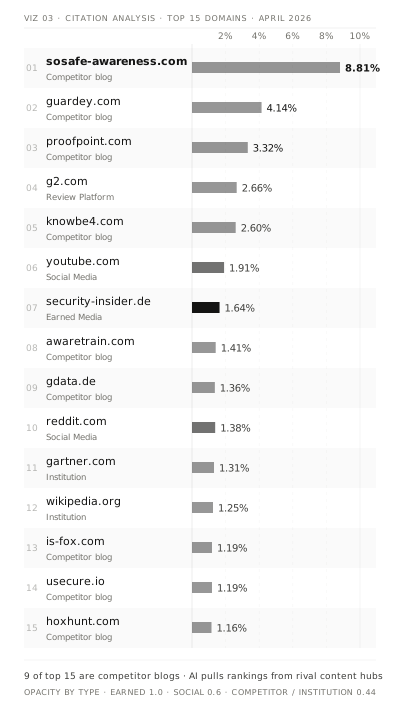
Eight of the top 15 domains are websites of vendors themselves. Not product pages, but content hubs: sosafe-awareness.com, guardey.com, proofpoint.com, knowbe4.com, awaretrain.com, gdata.de, is-fox.com, usecure.io. All of them regularly publish guides, comparison articles, glossaries — texts in which other vendors also appear by name. The AI cites this content regardless of which brand is in the foreground of the article itself. Anyone operating such a hub collects citations for themselves and, as a side effect, supplies the raw material the AI uses to derive rankings of competitors.
sosafe-awareness.com leads by a clear margin. 357 citations — almost twice as many as Guardey in second place. That explains SoSafe's lead in Visibility Score more directly than any marketing campaign could. When your own domain is the most-cited source in the category, your content becomes the basis for a disproportionate number of recommendations. On Google AI Overviews alone, the domain reaches 202 citations — 12.85 percent of all citations on that platform. No other source in the DACH AI ecosystem we have measured so far achieves such a high platform-specific share in its category.
guardey.com at rank 2 with 182 citations is the most striking structural pattern in the category. The brand has only 16.1 percent Visibility Score overall (rank 6), yet more citations than Proofpoint, KnowBe4 or Hoxhunt. The reason: a very broadly designed content hub, particularly strong on Perplexity (112 citations there alone, rank 2 behind SoSafe). Guardey benefits less from being named directly and more from having its content pulled in as a source for answers about other vendors.
security-insider.de at rank 7 with 75 citations is the single most important German-language cybersecurity trade publication in AI answers. Particularly strong on Perplexity (54 citations, rank 8 among cited domains there). Anyone missing from this outlet systematically loses ground on Perplexity.
g2.com (109 citations) is the most important third-party source. Especially strong on Perplexity (47) and ChatGPT (35), less so on Google AI Overviews. In some B2B categories G2 plays a lesser role — in security awareness the review portal is a central building block of the source mix.
gartner.com (44 citations) is almost exclusively prominent on ChatGPT: 41 of the 44 citations come from there. On the other platforms, Gartner plays almost no role. Brands relying heavily on Gartner and Forrester placements therefore need additional German-language signal sources for Perplexity and Google AI Overviews.
YouTube (78 citations) is one of the most underestimated AI sources. Product-related video content is regularly cited, considerably more often than LinkedIn. Particularly strong on Google AI Overviews with 79 citations at rank 2. In almost no AI visibility strategy we encounter in day-to-day client work does YouTube play a role so far. Across five report categories by now, our data consistently shows the same pattern.
Reddit (52 citations) carries specific weight in this category. IT admins discuss awareness products on r/cybersecurity, r/sysadmin and r/ITManagers — and the AI reads along. Particularly ChatGPT (27) and Google AI Overviews (28).
Conclusion: Who stands where — and where does potential remain?
SoSafe achieves the highest Visibility Score we have measured in a Recon Rise benchmark to date, at 63.6 percent, and leads four of the five buying moments. Average position 1.7 — the best in the category. This leadership rests on sosafe-awareness.com as the most-cited domain in the entire category, particularly strong on Google AI Overviews (84.8% Visibility Score). The measurable weak point is phishing simulation, where SoSafe sits at rank 4 with 41.6 percent — a category dominated by email security vendors like Proofpoint and Cofense. A second, quieter weak point is ChatGPT, where SoSafe and KnowBe4 tie at 54.3 percent. English-language trade press and US review portals are less densely covered than the German trade sources.

KnowBe4 sits at rank 2 overall with 48.0 percent and ties with SoSafe for the top spot on ChatGPT. The global market leader doesn't consistently sit at the top in AI answers, but holds the second row stably, with scores between 43.4 percent (Perplexity) and 54.3 percent (ChatGPT). Its own domain, knowbe4.com, reaches 104 citations — a third of the sosafe-awareness.com numbers. In AI answers, KnowBe4 is therefore mentioned more often than it is cited as a source. The position is currently carried by established brand recognition, not by fresh source work. Against a vendor building content systematically, that gap widens over time.

Proofpoint sits at rank 3 overall with 35.8 percent and leads the phishing simulation category with 53.1 percent. No coincidence. Proofpoint comes from the email security segment, and the term "phishing" is firmly linked to that heritage in the sources. In Human Risk Management (38.7%), the brand is also stronger than its average. It's weak in NIS-2 (15.9%) and Security Awareness Training (27.2%), precisely where German compliance and training framing dominates. Less a gap than a question of positioning: Proofpoint wins where its product origin aligns linguistically, and loses against specialised awareness vendors.
Hoxhunt at rank 4 with 31.8 percent, showing strong platform asymmetry. 49.0 percent on ChatGPT (rank 3), 33.3 percent on Google AI Overviews (rank 3), only 13.1 percent on Perplexity (rank 5). A classic profile of a European scale-up with a strong US go-to-market strategy: English-language sources and G2 are densely covered, the German-language comparison portal presence is not. In the Competitive Comparison category (52.7%), Hoxhunt runs far above its average — the brand has successfully established itself as a KnowBe4 alternative. If it closes the Perplexity gap, it moves into Proofpoint territory.

MetaCompliance at rank 5 with 18.4 percent, and at 37.1 percent on ChatGPT the highest-ranked compliance brand (rank 5). Solid in Competitive Comparison (26.3%) and Human Risk Management (19.9%), dominant nowhere. The Northern Irish brand has a markedly stronger profile on ChatGPT than on the other platforms. On Perplexity, the score collapses to 3.0 percent — a 34 percentage point delta between two platforms. This structurally limits DACH visibility.

Guardey is the strategically most striking case in the report. Rank 6 in the overall ranking with 16.1 percent, but rank 2 in citations with 182 hits. The Dutch brand is recommended by name less often than one might expect, but its content is frequently cited as a source for answers about other vendors. On Perplexity it reaches rank 4 with 24.2 percent, well above its overall average. On ChatGPT, by contrast, rank 10 with 7.3 percent. A case study for how a mid-sized B2B vendor can build AI visibility without being a market leader: the company's own content hub becomes the source from which the AI builds its answers — keeping the brand implicitly present in nearly all category answers.
G DATA at rank 7 with 13.4 percent, but at 39.1 percent in Security Awareness Training (rank 3). A German specialist with a strong core category and hardly any presence outside it. In Competitive Comparison, Phishing Simulation and Human Risk Management, G DATA is below 5 percent. The German SEO base works on Google AI Overviews; on ChatGPT and Perplexity, the brand drops off considerably. Expanding beyond Security Awareness Training would require broader cross-platform source work.
Awaretrain at rank 8 with 10.9 percent, centred on Security Awareness Training (33.3%, rank 4) and with above-average presence on Google AI Overviews. A similar profile to G DATA: solid in the core category, weak outside it. awaretrain.com reaches 56 citations — an active content base, but not enough to break into the overall top 10 on ChatGPT or Perplexity.
Phished at rank 9 with 9.7 percent. The Belgian brand is present in all five categories roughly evenly, without a clear focus. Solid visibility without a clear profile. A breakthrough would require actively owning a category — in Phishing Simulation, Phished currently does not make the top 10.
The German midfield below the top 10 — IS-FOX, Hornetsecurity, secunet — is placed noticeably weaker in AI answers than brand recognition in DACH would suggest. IS-FOX and Hornetsecurity are visible almost exclusively on Google AI Overviews, practically not on ChatGPT and Perplexity. The classic picture of vendors with a strong German SEO base but no systematic work on AI retrieval sources: Google search works, AI answers don't. Most direct lever: trade press placements in security-insider.de, it-daily.net, Computerweekly, plus G2 and Capterra entries that are missing so far.
One last look is worth taking — at the language of the relevant sources. The dominant citation domains split fairly clearly: English-language authority sources like Wikipedia and Gartner are found almost exclusively on ChatGPT. German-language trade press and comparison portals (security-insider.de, it-daily.net, capterra.com.de, ihk.de, bund.de), on the other hand, are cited mainly on Perplexity and Google AI Overviews. G2 runs across all three platforms, but is strongest on Perplexity. Anyone visible on only one language layer gets only a subset of the platforms. Anyone present on both — as SoSafe is — dominates.
What Recon Rise does
This report shows the category. We show where a brand stands within it — and then build what's missing.
An AI Visibility Audit measures current visibility on ChatGPT, Google AI Overviews and Perplexity, broken down by topic, platform and position. After that comes the operational work: building the sources the AI actually draws on for your category. Placing earned media, developing comparison content, setting up data structures. The infrastructure that makes a brand appear in the right answers — sustainably, not as a one-off.
For anyone who wants to see what this would look like for their own brand: Get in touch
Methodology
Profound AI Visibility Monitoring · 25 visibility prompts across 5 topic areas: Security Awareness Training, Phishing Simulation, NIS-2 & Compliance, Human Risk Management, Competitive Comparison · Measurement period: April 2026 · Platforms: ChatGPT, Google AI Overviews, Perplexity · Multiple executions per prompt and platform · 317 unique brands identified · Citation analysis based on 4,724 citations from 695 unique domains · Region: Germany · Language: German · Category: Cybersecurity / Human Risk Management
AI Visibility Index DACH 2026 — Human Risk Management Recon Rise GmbH · Düsseldorf · reconrise.ai © 2026 Recon Rise. All rights reserved.
Recon Rise, Düsseldorf · reconrise.ai
© 2026 Recon Rise. Alle Rechte vorbehalten.